• Skip to primary navigation
  • Skip to main content
  • Research Scholarships & Stipends
  • Living on Karst
  • Project Underground
  • Links
  • Directors
    • Login
    • Director’s Registration
Cave Conservancy of Virginia
  • Home
  • CCV Projects
  • Grant Requests
  • Officers & Board
  • Membership
  • Galleries
    • Photos
    • Videos
  • Contact Us

News

CaveSim programs supported by CCV for 2025

Report prepared by Dave Jackson, NSS 60740 RL FE, revision 1, November 9, 2025

Introduction

On behalf of CaveSim, I want to thank the Cave Conservancy of the Virginias (CCV) for very generously supporting CaveSim events in Virginia in September and October of 2025. With CCV support, we were able to educate many children and adults about cave conservation, science, and exploration. All of the people who participated responded very enthusiastically to the programs, and we made a point of sharing information about CCV and about local grottos and the National Speleological Society (NSS) with visitors who seemed interested in learning more about cave exploration. My goal is to create several generations of people who care about caves and cave conservation, and I am very grateful to CCV for helping to advance this goal. I hope that you feel that the support is worthwhile, and I am happy to answer any questions that come up from the CCV board.

Dave Jackson
Click here to see full PDF report.

Cave Bio Blitz in South-Wests Virginia

By: Penelope Vorster, Virginia Department of Conservation and Recreation, Natural Heritage

From January 10th to 18th, the Virginia Department of Conservation and Recreation -Natural Heritage’s Karst program conducted a cave-focused BioBlitz in southwest Virginia with volunteers from the Virginia Speleological Survey (VSS), the Cave Conservancy of the Virginias (CCV), Friends of the Cedars, and local caving organizations, including the VPI Cave Club and Walker Mountain Grotto. This collaborative effort supported a wide range of activities, including cave surveys, bio collections, photography, cave entrance cleanup, landowner service projects, landowner communication and education, and data preparation.

A primary goal of the event was to pair seasoned cave explorers and karst scientists with new, enthusiastic cavers to mentor them in biological inventory methods and cave exploration. Over the course of the week, 40 participants – including 16 mentee explorers – surveyed 20 caves across South West Virginia. The group contributed over 2.5 miles of mapped cave passage to the VSS database, documented several new bat EOs, updated bat records at additional sites. Subterranean fauna inventories were conducted in caves throughout the region, with some sites surveyed for the first time.

The DNH Karst Program is grateful to all our volunteers and collaborators who made this event possible. We would especially like to recognize VSS Director Mike Futrell for identifying priority cave sites and coordinating with many of the landowners; The CCV for generously funding accommodations for volunteers at Natural Tunnel State Park; and our own Zenah Orndorff for coordinating with volunteer logistics and ensuring that participants were well prepared and had fulfilling roles throughout the week.

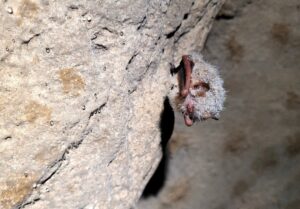
A hibernating Perimyotis subflavus (Tricolor Bat), hibernating in Fugate Cave in Scott Co., VA.

A volunteer from the VPI Cave club searches for invertebrates in the stream. Blair-Collins Cave, Scott Co., VA.

CaveSim is coming to Virginia October 2025

Cave Sim is coming to Virginia on October 18 and 19, 2025. They will be part of Roanoke’s GoFest. See the Cave Sim web site for information on what Cave Sim is all about.

October 18 and 19 (Saturday and Sunday). GoFest in Roanoke, VA

Butler Cave Conservation Society Karst Educational Trail

Summer 2022

Butler Cave Conservation Society, Inc.
465 Karst Ridge Drive
Williamsville, VA 24487

Description

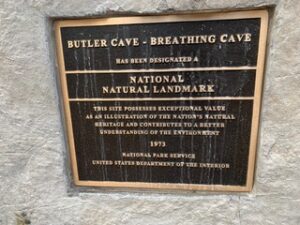
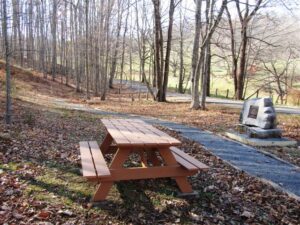
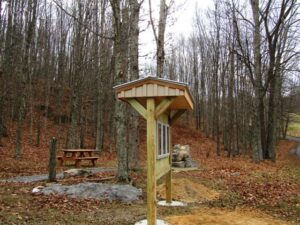
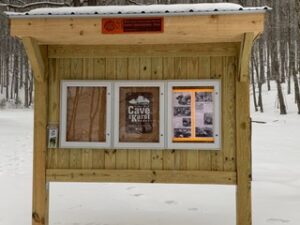
The aim of this project will be to make key infrastructure improvements on a property owned by the Butler Cave Conservation Society (BCCS). The property is formally called the Postmaster’s House Preserve, which was purchased in 2019 by the BCCS for use as a secondary field house and to protect the natural resources across the property. The position and nature of this property having easy road access, electric power, and convenient karst features abound, makes it an exceptional location for our proposed improvements. Included in these improvements, we hope to establish an educational kiosk to display information about caves, karst, speleology, the BCCS’ operations, and our history as a society. Inviting those who stop at the kiosk to explore the property, we hope to build an improved karst exploration trail into and around the karst features of the site. Finally, at the end of the trail loop, we hope to build a proper spectator viewing deck, which will overlook the “Steamer Hole” sinkhole at the edge of the property. These key improvements will create a perfect opportunity for the public to learn more about caves, karst, and how and why our society, and others like us, protect and study these extraordinary natural resources.

Photos

Fullers Cave (WV) research concerning scallops, flooding, and sediment transport

Summer 2023

Dr. Gregory S. Springer, Chair
Department of Geological Sciences
Ohio University
Athens, Ohio

Description

Science and an Accident in Fullers Cave

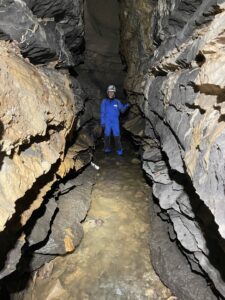
Typical Passage for probes

Fullers Cave is a tributary within the Culverson Creek Cave System, which consists of a 1.5-mile-long canyon that intersects the main Culverson Creek Cave trunk near the downstream terminus. Fullers drains Thorny Hollow and is notable for its dynamic flooding and unstable areas near its sinkhole entrance. My graduate students and I have been performing research in Fullers since 2018 concerning scallops, flooding, and sediment transport. A typical Fuller canyon passage is shown in a photo that accompanies this article. The Fullers stream is transporting large cobbles that are visible in the photo.

The scallop research indirectly led to a publication in the International Journal of Speleology with my former student Drew Hall (Springer and Hall, 2020), and the flooding research produced a paper in the same journal with Lydia Albright (Albright and Springer, 2022). Drew and Lydia were two of the best MS students I have worked with, and their results directly led to ongoing work in Fullers with my current student Sydney Hansen.

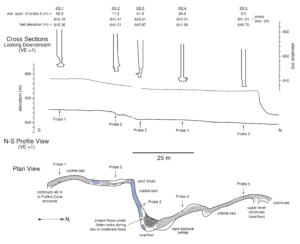
We are studying a 300-foot-long stretch of the Fullers canyon wherein we have placed probes to continuously monitor water levels. The reach is about 500 feet downstream of the Fullers sinkhole entrance. The canyon reach we are studying is shown in a figure that accompanies this article in both plan and profile views.

The water level data is combined with stream discharge measurements made outside of the cave to calculate a variety of things and to model flood flow. We use either an electromagnetic flow meter or the salt dilution method to determine discharge. The salt dilution method involves dumping a known quantity of salty water in floodwaters and measuring water conductivity downstream. The amount of dilution that occurs between where the salt solution was dumped, and conductivity is measured is used to calculate discharge.

The probes were purchased by Ohio University, but the conductivity probes for salt dilution measurements were purchased with grants from the Cave Conservancy of the Virginias (CCV) and the West Virginia Association for Cave Studies (WVACS). The CCV probe is also being used in Dry Cave. I note that we only use salt dilution during floods and the salty water is too diluted to hurt critters living in the stream.

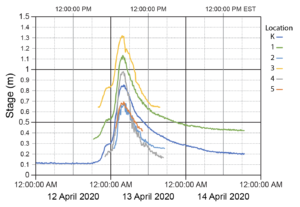
In total, we have five water level probes in the study reach (see map). They measure water level every 10 minutes and hydrographs are shown in another figure accompanying this article. Notable, the in-cave probes are only submerged during floods, so their hydrographs are blank until floodwaters reach them.

As you can see from the hydrographs, Fullers floods quickly, although the flood shown here is modest compared to those that fill the lower 20 feet of the canyon. Nonetheless, Lydia was able to determine water velocities during floods (~1.5 meters per second) and quantitatively determine the hydraulic roughness of the channel. Roughness is hard to measure, so our study is unique.

Sydney is modeling sediment transport in Fullers as part of her MS thesis. This entails modeling floods in the same canyon reach as Lydia, but Sydney’s model will incorporate movement of cobbles in the stream. Such studies are rare in caves, so her work will be as or more unique than Lydia’s.

Passage Cross Sections at probes, looking downstream

In support of Sydney’s thesis, we spent a week in May collecting data in the cave. We were accompanied by field assistants Logan Leffler and Xandra Rowen. This article focuses on that fieldwork and a few results we have generated. Logan and Xandra are geology undergraduates who volunteered to help Sydney and proved invaluable.

Sydney had previously painted rocks in the Fullers stream to track sediment movement. The May work included measuring the dimensions of the painted rocks that moved and how far they traveled. We also emptied a sediment trap Sydney installed earlier in the year. The trap had filled with sediment, and we measured the total mass of sediments trapped and the dimensions of larger grains. The sediment measurements required a day of work, and the rest of the week was spent surveying.

Sydney, Logan, and Xandra found measuring the painted rocks quite the ordeal given that 108 rocks had moved, and each required three length measurements in addition to being weighed. Mind numbing is one way to describe the work. Of course, as Sydney’s advisor, I provided excellent supervision and religiously avoided directly getting involved. However, I didn’t escape unscathed.

The sediment trap was overflowing with water in addition to 200kg of sediments. Someone had to spend hours excavating the sediments so they could be weighed, and dimensions measured where necessary. Unfortunately, I was that someone. It was May, but that doesn’t mean the cave stream was warm! We made all the necessary measuremenrts, but we observed several deficiencies in the trap’s operation, so we ended up removing it later that week.

The surveys entail three separate activities. First, Sydney is surveying the canyon using typical caver methods, with the goal of producing a map like the one that accompanies this article. However, her map will start at the entrance and extend 1000 feet downstream. Second, a detailed profile of the streambed is being surveyed with measurements roughly every meter. Third, detailed cross sections are being measured in the study reach. All of this takes time, and we are not done yet.

Sydney, Xandra, and Logan began the traditional-style cave surveying on the last day of fieldwork. They continued downstream from the study reach, which I had previously surveyed to produce the map with this article. I typically train students to pursue necessary tasks but have them lead trips without me for reasons of professional and personal development. So, I did not accompany them on the survey, but checked on them later.

Probe Hydrographs

Sydney et al. drove to Fullers and got to work while I walked from WVACS to Fullers via the Buckeye and Williamsburg roads. They had my caving gear in the car, so I didn’t have to carry it on the walk in addition to my weighed hiking backpack. The walked proved to be 5.8 miles long and was very interesting. There were ample exposures of the Greenbrier limestones and colluvial and alluvial deposits in cutbanks of Buckeye Creek. I took a lot of pictures and made a variety of GPS way-points!

Eventually, I reached the car at Fullers and changed into my caving gear and headed to the cave to join the others. Here is where things got really interesting… There are three waterfalls between the Fullers sinkhole entrance and our study reach. I passed the first two without any problems, but after having been in Fullers dozens of times, I was being lackadaisical and not totally paying attention to what I was doing. Never take a cave for granted!

As I started the last climb-down, I misplaced my left foot and found myself falling down the 6-foot-high drop. My left arm had been braced against the wall as I placed my foot, so to keep from falling on the rocks below, I instinctively used my right leg to push my left side and arm against the wall.

I fell just enough for my left arm to be raised above my head, but I had to push so hard to my left that there was a LOUD pop in my left shoulder! And I mean loud. The pain was so intense that I don’t remember what happened next. I just remember ending up below the drop bent over in horrible pain. At first, I thought I had dislocated my shoulder, but I realized it was in the socket. So, either it popped out and back in, or something else had happened.

Despite the pain, I went downstream and found the others just as they finished their survey. I couldn’t lift my left arm, so I told them I was leaving, and, in fact, we all exited. That was the last day of fieldwork and a few days later the pain drove me to Urgent Care. An MRI showed my rotator cuff is torn in two places. An orthopedic surgeon would later tell me surgery probably wouldn’t help much, so we are in a wait and see situation.

Fortunately, I was later cleared to resume activities and told my main limitation would be pain tolerance. The arm is usable, but even with a cortisone shot it gets angry when I do certain things. Such is the price for not paying attention in a cave.

We will pursue more fieldwork in July and August. A lot surveying remains to be done, which is not difficult. Just time consuming. Eventually, the work will result in a thesis for Sydney and a publication. I can only hope her thesis’ acknowledgement section thanks my shoulder for taking one for the team. J

References

Albright, L., and Springer, G., 2022, Empirical roughness coefficients for moderate floods in an open conduit cave: Fullers stream canyon, Culverson Creek Cave System, West Virginia: International Journal of Speleology, v. 51, p. 123–132, doi: https://doi.org/10.5038/1827-806X.51.2.2436.

Springer, G., and Hall, A., 2020, Uncertainties associated with the use of erosional cave scallop lengths to calculate stream discharges: International Journal of Speleology, v. 49, p. 27–34, doi: https://doi.org/10.5038/1827-806X.49.1.2292.

  • Page 1
  • Page 2
  • Go to Next Page »

Copyright © 2026 Cave Conservancy of the Virginias. All Rights Reserved.

The contents of this website may not be reproduced in any way without the written consent of the publisher, Cave Conservancy of the Virginias (CCV). Other authors may also claim copyright on individual pages. Trademarks are the property of their respective owners. CCV Office: 13131 Overhill Lake Lane | Glen Allen, VA 23059 | 804-798-4893